Lazy Eye Surgery
- Get link
- X
- Other Apps
If you are searching for lazy eye surgery for adults, you have probably been living with an eye that drifts, turns, or feels “off” for years. You may have called it a lazy eye your whole life. You may have been told as a child that you would outgrow it — or that nothing could be done once you were older.
At PES Adult Strabismus Center, many adult patients start exactly there. They do not walk in using the word strabismus. They say, “I’ve always had a lazy eye.”
This article exists to meet you where you are. It will clarify what is actually happening, what surgery can and cannot fix, what lazy eye surgery cost typically looks like, and whether treatment is worth it in adulthood.
What Do Doctors Mean When They Say “Lazy Eye”?
Most people use the term “lazy eye” to describe an eye that visibly turns. Medically, however, two different conditions are often confused under that label.
Strabismus is when the eyes are physically misaligned. One eye may turn inward, outward, upward, or downward. This is what people usually notice in photos or in the mirror.
Amblyopia is reduced vision in one eye because the brain favored the other eye during childhood development. The eye may look completely straight but still see poorly.
These conditions are related but not identical. Strabismus is one of the most common causes of amblyopia, which is why the terms are often mixed together in everyday conversation.
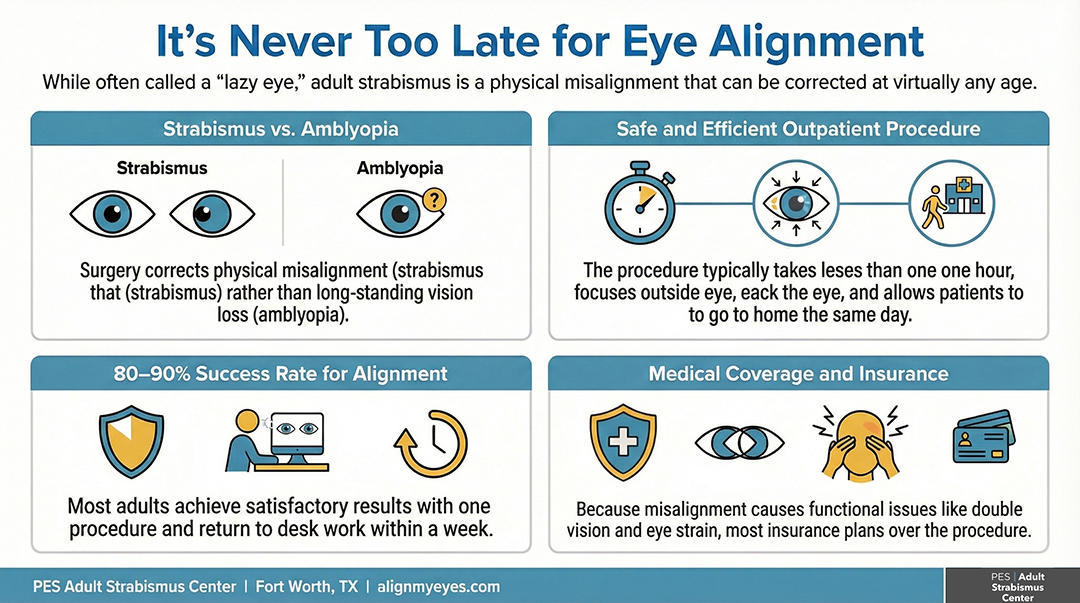
Understanding this distinction matters because surgery treats misalignment. It does not directly reverse long-standing vision loss from amblyopia.
Can Lazy Eye Surgery for Adults Actually Correct the Problem?
Yes, if the issue is strabismus — the physical misalignment — it can be corrected in adults.
There is a long-standing myth that strabismus must be treated in childhood or not at all. That belief is outdated. Adults are not too old for surgery and eye muscle alignment can be improved at virtually any age.
However, if reduced vision from amblyopia developed during childhood, surgery will not typically restore full visual acuity in that eye. The brain’s critical window for visual development largely closes before adolescence.
Many adults have both conditions. In those cases, surgery to fix lazy eye in adults corrects alignment. The eye may still be weaker in terms of sharpness, but it will appear straight and function better within the visual system.
At PES Adult Strabismus Center, this distinction is explained clearly during consultation so patients understand what outcomes are achievable.
What Does Surgery for Lazy Eye in Adults Involve?
The proper term for lazy eye surgery is strabismus surgery, also called eye muscle surgery. The procedure focuses on adjusting the muscles that control eye position so the eyes point in the same direction.
It is typically performed as an outpatient procedure under general anesthesia and usually takes less than one hour. Most adults go home the same day.
During surgery, specific eye muscles are either strengthened or weakened depending on the direction and degree of misalignment. In many adult cases, adjustable sutures may be used. This allows the surgeon to fine-tune alignment shortly after surgery while the patient is awake, increasing precision.
The idea of eye surgery can sound intimidating, but the procedure works on the extraocular muscles outside the eye, not inside the eyeball itself.
Can Botox Fix a Lazy Eye Instead of Surgery?
Botox is sometimes used as a treatment option for certain types of adult strabismus. Botulinum toxin temporarily weakens an overactive muscle, which can allow better alignment. In select cases — particularly small-angle deviations or certain nerve-related issues — Botox may provide meaningful improvement.
However, Botox is usually temporary. Some patients require repeat injections. Others ultimately choose surgery for longer-lasting correction. Whether Botox is appropriate depends on the type of misalignment, its severity, and the patient’s goals. It is not a universal substitute for surgery, but it can be part of the treatment conversation.
Request Your Consultation Today!
Receive a call from our senior leadership team before your appointment.
What Is the Recovery Time After Lazy Eye Surgery in Adults?
Recovery is one of the most common concerns for adults considering surgery. In the first few days, redness of the eye is expected. The eye may feel sore, irritated, or mildly swollen. Most adults describe the discomfort as manageable rather than severe.
Over the first few weeks, redness gradually fades and alignment stabilizes. Follow-up visits ensure healing is progressing normally. Many patients return to desk work within several days to one week, depending on comfort. Driving typically resumes once vision feels stable and safe. Full healing can take several months, and minor fluctuations in alignment early on are normal.
Is Temporary Double Vision Normal After Strabismus Surgery?
Yes, temporary double vision can occur after surgery, and it is usually part of the adjustment process. When the eyes have been misaligned for years, the brain adapts by suppressing input from one eye or by adjusting how it processes visual signals. After alignment is corrected, the visual system must recalibrate. That adjustment period can create temporary double vision. For most adults, this resolves within days to weeks.
How Much Does Lazy Eye Surgery Cost for Adults?
The question “how much is lazy eye surgery?” is one of the most searched online. The total cost of lazy eye surgery for adults generally ranges between approximately $5,000 and $10,000 or more, depending on complexity. Several factors influence the total cost, including the number of muscles involved, whether one or both eyes are treated, facility fees, anesthesia, and the specifics of the surgical plan. At PES Adult Strabismus Center, we believe in price transparency, which is why the cost of surgery is discussed clearly after a comprehensive evaluation, ensuring each adult strabismus treatment plan reflects the unique details of your case.
Is Lazy Eye Surgery Covered by Insurance?
In most cases strabismus surgery is covered by insurance. Strabismus surgery is considered a medical procedure rather than cosmetic. Misalignment can cause functional issues such as double vision, eye strain, headaches, and impaired depth perception. Because of these functional impacts, most health insurance plans provide coverage, though deductibles and copays vary.
For patients searching “lazy eye surgery for adults cost,” the financial picture often looks very different once insurance coverage is factored in. Verification and benefits review are part of the preoperative process at PES Adult Strabismus Center.
Is Lazy Eye Surgery Worth It for Adults?
Adult strabismus surgery has high success rates with approximately 80–90% of adults achieving satisfactory alignment with a single procedure. Some may require a second surgery for refinement due to the complexity of eye muscle balance.
Beyond physical alignment, many patients report meaningful improvements in confidence, eye contact, and comfort in professional and social settings. Alignment affects not only how the eyes function together but also how others perceive engagement.
It is important to recognize that results vary and the only way to determine what is realistic in your specific case is a comprehensive evaluation.
Why Does My Lazy Eye Get Worse When I Am Tired?
Many adults notice that their eye drifts more when they are fatigued, stressed, or ill. This happens because fatigue weakens the brain’s ability to maintain precise muscle coordination. If you have intermittent strabismus, your visual system may compensate well when rested but struggle when tired. As a result, the deviation becomes more noticeable.
This is not imagined or psychological. It is a real physiological response. For some patients, increasing frequency of drift when tired is an early sign that the condition may benefit from treatment before it becomes constant.
What Are the Next Steps If I Am Considering Surgery to Fix Lazy Eye in Adults?
An adult strabismus consultation determines whether you have strabismus, amblyopia, or both. It clarifies whether surgery, Botox, or observation is appropriate. It also provides individualized information about recovery, risks, and insurance coverage.
At PES Adult Strabismus Center, the focus is exclusively on adult eye misalignment. The team understands that most patients arrive using the term “lazy eye.” The goal is not to correct vocabulary — it is to provide clarity so that you can get the help you are seeking.
If you are searching for how to fix lazy eye in adults, the honest answer is this: alignment can almost always be improved. Visual sharpness depends on your history. And the only way to know what is possible in your case is through a detailed assessment.
For many adults, the most surprising discovery is not the surgical technique. It is learning that they were never “too late” to seek help. If you’re ready to find out what’s truly possible for your eye alignment, schedule an evaluation with PES Adult Strabismus Center now and get clear answers, transparent pricing, and a treatment plan built specifically for you.
from Lazy Eye Surgery https://ift.tt/2lwx0yn
via PES Adult Strabismus Center
- Get link
- X
- Other Apps

Comments
Post a Comment